

 Expanded Metal Products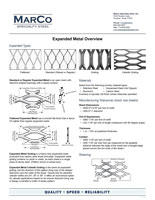
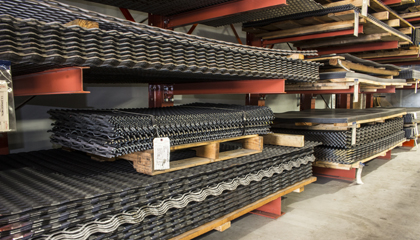
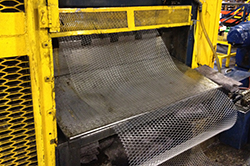
Expanded metal products consist of sheets or coils of solid metal that feature a diamond pattern that vary by gauge, type of material, and size of the diamond. The term “expanded metal” refers to the way the metal is simultaneously die-cut and expanded as it moves through the progressive dies on a press. This process allows it to be expanded up to 10 times its original size, while losing up to 80 percent of its original weight per square foot and retaining its form and rigidity.
Choose from Three Expanded Metal Types
Marco Specialty Steel offers three varieties of expanded metal to meet the needs of companies in a broad range of industries:

Standard Expanded Metal (SXM): see tables
Standard expanded metal, or raised metal, is a finished product that comes from the press after having been die-cut and expanded. The strands and bonds form a sharp angle to the original plane of the solid sheet. This standard type provides maximum flexibility for adapting the open area percentage to meet the project requirements. Read more about standard expanded metal.
Flattened Expanded Metal (FXM): see tables
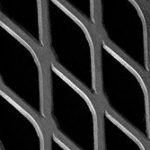
Flattened expanded metal is a standard expanded metal product that has been cold rolled leaving a flat, smooth surface. This flat version is also about 5% lighter than the standard version, making it well suited for applications requiring agility, while still maintaining maximum strength and durability. Architects frequently choose the flattened version when designing ornamental accents. Read more about flattened expanded metal.
Expanded Metal Grating: see tables
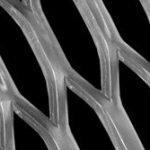
Expanded metal grating is a heavy-duty expanded metal produced from a carbon steel sheet and plate. This metal grating contains no joints or welds, as each sheet is a single piece of sturdy steel. They are easy to install and maintain while offering a more economical alternative to traditional bar grating materials. Carbon steel expanded metal sheet grating creates a stable, slip-resistant surface on stairs, platforms, catwalks, and pedestrian walkways. Read more about expanded metal grating.
Expanded Metal Uses and Applications
Expanded metal’s strength, versatility, and other beneficial properties enable it to be used for a wide range of industrial and manufacturing applications, including:
- Architectural interior partitions and barriers
- Architectural for a building’s facade
- Expanded metal security fencing is a security fence that not only provides protection but also has an elegant look with its uniform structure and rigidity. It is widely used for blocking climbing and keeping out trespassers and thieves.
- EMI/RFI Shielding
- Security mesh a/c covers
- Window, door, and skylight guards
- Walkways, mezzanines, catwalks, stairways, and ramps
- Air intake screens
- Expanded metal infill panels used in all industries
- Cab/truck dividers
- Concrete reinforcement
- Drive and sidewalk grates
- Light diffusers
- Anti-slip flooring such as maintenance platforms and billboard platforms
- Machine guards


Expanded Metal Custom Fabrication Services

If you can’t find the right expanded metal product in our stock inventory, it’s not a problem! Our 35,000-square-foot Houston, TX facility includes an in-house fabrication department where we can create the customized product that meets your requirements. Our expert staff consists of sales personnel, architects, engineers, designers, and other metal professionals who will work hard to bring your custom design to life. We can take your detailed cad drawings and create print takeoff lists to assist with your project.
Expanded Metal Finishes and Special Treatments
- Mill Finish
- Carbon Steel: lightly oiled and requires cleaning before final finish using acid or solvent bath with a water rinse
- Aluminum: Clean with a non-etching chemical or detergent, then rinse and dry thoroughly (A wax or non-wax based cleaner can be used)
- Hot Dip Galvanizing: Protective coating of zinc; may have a rough uneven appearance. Not applicable to patterns smaller than 1/4”
- Electro-Galvanized: Zinc finish applied to sheets to provide weather resistance
- Deburring: Remove burrs and sharp edges by wire brushing 9”-72” SWD, 50”-150” LWD. Not all styles will be deburred
- Leveling: A plane of the sheet leveled without flattening strands or bonds
- (Anodized, Coated, Painted or Plated expanded metal also available)
Expanded Metal Open Area Percentage
Why Is Open Area Percentage Important When Selecting an Expanded Metal Product?
Open area percentage refers to the amount of open space in the pattern for allowing air, light, water, and materials to pass through. The larger the open area percentage, the large the size of the particles or materials that can filter through the product’s parallel wires. Marco Specialty Steel can help you select the optimal perforated metal open area percentage for your applications.
Expanded Metal Benefits and Characteristics
Benefits
Expanded metal offers several valuable benefits for designers, manufacturers, and facility operators.
Expanded metal mesh is a lightweight, versatile material that offers a higher strength-to-weight ratio than sheet metal. The process of expanding the metal from its solid sheet form actually strengthens the material. Because the mesh is formed from a single piece of metal, it is amenable to further processing, such as shearing or pressing.
The expansion process results in the formation of “knuckles” that make expanded metal products ideally suited for anti-slip surfaces. The attractive diamond pattern also makes expanded metal perfect for architectural/design purposes.
Characteristics
Despite its relatively lightweight, expanded metal is stronger than other wire mesh materials of similar weight. Because the material is flattened, it can remain as one piece instead of being welded or fused together as separate components. This eliminates the creation of seams that could come apart at some point during the product’s lifespan.
While expanded metal products typically exhibit a diamond-shaped pattern — which provides excellent energy absorption and resistance to deformation — it’s possible to achieve circular and square configurations. The angle of the placement of the shape plays an important role in the performance of the product. For instance, a zero angle will create straight lines across the sheet, resulting in greater strength when compressing the sheet on its side.
Expanded metal’s versatility makes it suitable for use with numerous metal materials. Aluminum, carbon and stainless steel expanded metal sheets are all widely used in the manufacturing of products as diverse as security fencing, air intake screens, patio furniture, and machine guards. You’ll also find heavy gauge expanded metal products for applications that demand maximum strength, as well as coated expanded metal materials that offer additional corrosion protection.
Marco Can Provide the Right Expanded Metal Products for Your Applications
As one of the top expanded metal suppliers in the U.S., Marco Specialty Steel can offer a wide variety of high-quality 304 and 316 stainless steel expanded metal products featuring numerous thicknesses, open areas, patterns, and design options. Other expanded metal product offerings include carbon steel, galvanized metal, aluminum, metal grating, and architectural. We’re constantly looking to add to our large inventory to meet the evolving needs of our customers.
We also have a stocked inventory of expanded metal accessories to make the most of your purchase.
Who Is Marco Specialty Steel?
Marco Specialty Steel sells expanded metal in Houston, TX, and all over the United States. We are a fully equipped steel service center that has been providing customer-focused solutions for companies throughout the metals industry since 1992. The combination of superior products, extra effort, care, and close attention to detail is what separates us from our competitors. Perhaps that’s why so many companies turn to us for all their metal and steel product needs. Visit our about page to view our corporate video to learn more about us.
Frequently Asked Questions About Expanded Metal
Below are some of the most common questions we receive about our expanded metal products, materials, and fabrication capabilities.
What is expanded metal?
Expanded metal is created by slitting and stretching a sheet of metal into a mesh pattern. The process forms diamond- or hex-shaped openings without any material loss, making it lightweight, durable, and economical.
What metal materials are available for expanded metal?
Standard materials include carbon steel, aluminum, stainless steel, and both pre-galvanized and hot-dip galvanized steel. Specialty alloys such as Monel, Inconel, and Hastelloy are also available by special order.
What are the types of expanded metal?
There are three main types: Standard (raised), Flattened, and Expanded Metal Grating. Standard expanded metal has angled strands that provide traction and strength; flattened expanded metal is cold-rolled for a smooth surface; and expanded metal grating features thicker strands and larger openings, making it ideal for heavy-duty industrial flooring and catwalk applications.
What do SWD and LWD mean for expanded metal?
SWD (Short Way of the Diamond) and LWD (Long Way of the Diamond) refer to the dimensions of the diamond openings in expanded metal. These measurements define the mesh pattern and are critical for determining load-bearing capacity, airflow, and appearance.
What is the difference between random shearing and bonded shearing?
Random shearing cuts through the expanded pattern, creating slightly uneven edges. Bonded shearing trims along the bond lines for clean, uniform edges and consistent panel sizing. Marco Specialty Steel can perform both methods depending on your specification and edge requirements.
Why is the percent of open area important for expanded metal?
The open area determines the balance between strength, airflow, visibility, and weight. Higher open area allows more air and light through but reduces rigidity. Selecting the proper open area ensures performance for filtration, ventilation, or safety applications.
How is expanded metal measured and specified?
Expanded metal is defined by strand thickness, strand width, and opening size — known as the SWD (short way diamond) and LWD (long way diamond). These dimensions determine strength, rigidity, and open area. Our team can help you select the right configuration for your load, span, and design needs.
What are common applications for expanded metal?
Expanded metal is used for walkways, platforms, machine guards, security enclosures, fencing, architectural facades, and filtration. It provides strength, airflow, and visibility while minimizing weight and material cost.
Do you stock expanded metal or make it to order?
Both. Marco Specialty Steel stocks a large inventory of standard expanded metal sheets in carbon steel, stainless steel, and aluminum. We also fabricate custom panels, cut-to-size sheets, and expanded metal grating for specialized projects.
What are the industrial uses for expanded metal?
Expanded metal is widely used in oil and gas facilities, refineries, power plants, water treatment, and manufacturing plants. Its durability and anti-slip surface make it ideal for platforms, catwalks, and equipment enclosures in harsh industrial environments.
Can expanded metal be used for architectural projects?
Absolutely. Expanded metal is a popular choice for sunscreens, cladding, partitions, and railing infill panels. It provides a modern industrial aesthetic while allowing airflow, light, and partial visibility.