

Molded or Pultruded Fiberglass Grating: Which Is Right for Your Application?
Molded or Pultruded
Fiberglass Grating:
Which Is Right
for Your Application?
Molded fiberglass grating is generally recommended for corrosive environments and complex layouts, while pultruded fiberglass grating is often the better choice for long spans and heavy loads. This guide is intended for engineers, contractors, facility managers, maintenance teams, and anyone responsible for selecting FRP grating. Choosing the right grating can impact safety, performance, maintenance requirements, and long-term project costs. Below, we’ll compare molded and pultruded fiberglass grating, explain their advantages and limitations, and help you determine which option is best for your application.
Fiberglass reinforced plastic (FRP) grating has become a popular alternative to steel grating because it offers excellent corrosion resistance, a high strength-to-weight ratio, and low maintenance requirements. However, the manufacturing process used to produce molded and pultruded grating creates important differences in strength, span capability, and performance that should be considered before making a selection.
Understanding the differences between molded and pultruded FRP can help engineers, maintenance personnel, and project managers select the right material for their specific application.
 What Is Molded Fiberglass Grating?
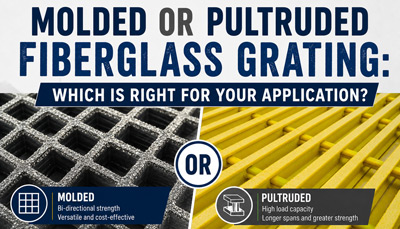
Molded fiberglass grating is manufactured by placing continuous fiberglass rovings into a mold and saturating them with resin. The grating is formed as a single panel with fiberglass reinforcement running in both directions.
This manufacturing process creates a grating panel with bi-directional strength, making it suitable for applications where loads may come from multiple directions.
Common Advantages
- Excellent corrosion resistance
- Bi-directional load distribution
- Easy field fabrication and modification
- Available in various mesh sizes
- Slip-resistant walking surfaces
- Cost-effective for many general-purpose applications
Typical Applications
- Chemical processing facilities
- Wastewater treatment plants
- Marine environments
- Walkways
- Platforms
- Trench covers
- Cooling towers
 What Is Pultruded Fiberglass Grating?
Pultruded fiberglass grating is manufactured by pulling continuous fiberglass reinforcements through a resin bath and heated die to create structural bearing bars. These bars are then assembled into grating panels.
Unlike molded grating, pultruded grating is designed with most of its strength concentrated in one direction, similar to traditional steel bar grating.
Common Advantages
- Higher load capacity
- Greater span capabilities
- Superior stiffness
- Lower deflection under load
- Lightweight construction
- Ideal for heavily loaded areas
Typical Applications
- Industrial platforms
- Elevated walkways
- Pipe racks
- Equipment access platforms
- Offshore facilities
- Structural flooring systems
- Areas requiring long unsupported spans
Molded vs. Pultruded Fiberglass Grating: Side-by-Side Comparison
| Feature | Molded Fiberglass Grating | Pultruded Fiberglass Grating |
| Manufacturing Method | One-piece molded construction | Pultruded bearing bars assembled into panels |
| Strength Direction | Bi-directional | Primarily one-directional |
| Corrosion Resistance | Excellent | Excellent |
| Span Capability | Moderate | Excellent |
| Load Capacity | Moderate | High |
| Deflection Resistance | Good | Excellent |
| Ease of Modification | Excellent | Good |
| Weight | Lightweight | Lightweight |
| Typical Cost | Lower | Higher |
Understanding the Differences Between Molded and Pultruded Fiberglass Grating
- Strength and Load Capacity
- One of the biggest differences between the two products is how they handle loads.
- Because pultruded grating utilizes continuous fiberglass reinforcement running in the bearing bar direction, it generally provides higher strength and can span longer distances than molded grating.
- For applications involving heavy equipment, larger spans, or higher live loads, pultruded grating is often the preferred choice.
- Molded grating still provides excellent performance for many industrial and commercial applications but typically requires more support points when compared to pultruded grating.
- Load Direction
- Molded grating offers strength in both directions because of its integral construction.
- This makes molded grating particularly useful in areas where traffic patterns are unpredictable or loads may be applied from multiple directions.
- Pultruded grating performs best when loads are applied perpendicular to the bearing bars, similar to traditional bar grating systems.
- Corrosion Resistance
- Both molded and pultruded grating provide outstanding corrosion resistance when manufactured with the appropriate resin system.
| Resin Type | Resin Base | Description | Corrosion Resistance | FlameSpread Rating ASTM E84 | Product | Available colors | Max. Oper. Temp. |
|---|---|---|---|---|---|---|---|
| Type V | Vinyl Ester | Superior Corrosion Resistance and Fire Retardant | Excellent | Class 1, 25 or less | Molded & Pultruded | Dark Grey, Orange, Yellow | 200 F |
| Type I | Isophthalic Polyester | Industrial Grade Corrosion Resistance and Fire Retardant | Very Good | Class 1, 25 or less | Molded & Pultruded | Green, Yellow, Light Grey | 150 F |
| Type F | Isophthalic Polyester | Food Grade Corrosion Resistance and Fire Retardant | Very Good | Class 2, 75 or less | Molded | Light Grey | 150 F |
| Type O | Ortho | Moderate Corrosion Resistance and Fire Retardant | Moderate | Class 1, 25 or less | Molded | Green, Yellow, Light Grey | 150 F |
| Type P | Phenolic | Low Smoke and Superior Fire Resistance | Very Good | Class 1, 5 or less | Molded & Pultruded | Reddish-Brown | 300 F |
-
- The best choice depends on the chemicals, temperatures, and environmental conditions present in the application.
- For most corrosive environments, both molded and pultruded grating significantly outperform carbon steel and can provide years of maintenance-free service.
- Span Capability
- Pultruded grating typically offers longer unsupported spans than molded grating.
- This advantage can reduce the amount of structural support required, potentially lowering installation costs and simplifying project design.
- Applications such as elevated walkways, equipment platforms, and industrial access systems often benefit from the span capabilities of pultruded grating.
- Slip Resistance
- Both products can be manufactured with slip-resistant surfaces.
- Common surface options include:
- Concave surface (Meniscus Top)
- Gritted surface (optional grit top)
- Covered grating panels
- The best choice depends on the level of slip resistance required and the environmental conditions.
When Should You Choose Molded Fiberglass Grating?
Molded grating is often the best choice when:
- Corrosion resistance is the primary concern
- Loads are moderate
- Traffic may move in multiple directions
- Frequent field modifications are required
- Budget is a major consideration
- Shorter spans are acceptable
Many wastewater treatment facilities, chemical plants, and marine installations use molded grating for its versatility and corrosion resistance.
When Should You Choose Pultruded Fiberglass Grating?
Pultruded grating is often the better option when:
- High load capacity is required
- Longer spans are needed
- Deflection must be minimized
- Structural performance is critical
- Equipment or vehicle traffic creates higher loading requirements
Industrial platforms, elevated walkways, offshore facilities, and heavy-duty access systems commonly utilize pultruded grating for its strength and stiffness.
Can Molded and Pultruded Grating Be Fabricated?
Yes.
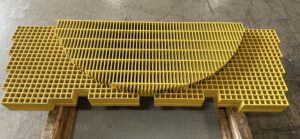
Both molded and pultruded fiberglass grating can be cut, notched, banded, and fabricated to meet project requirements.
Common fabrication services include:
- Cut-to-size panels
- Circular and irregular cutouts
- Notching around structural members
- Panel assemblies
- Stair tread fabrication
Proper fabrication ensures a precise fit and helps simplify field installation.
Which Fiberglass Grating Is Right for Your Application?
The right choice depends on your project’s loading requirements, span lengths, traffic patterns, environmental conditions, and budget.
In general:
- Choose molded fiberglass grating when corrosion resistance, versatility, and bi-directional strength are the primary considerations.
- Choose pultruded fiberglass grating when span capability, load capacity, and structural performance are the primary requirements.
Both products provide excellent corrosion resistance and long service life when properly selected for the application.
Quick FRP Selection Guide
| If Your Priority Is… | Recommended Grating |
| Corrosion resistance | Molded or Pultruded |
| Heavy loads | Pultruded |
| Longer spans | Pultruded |
| Reduced deflection | Pultruded |
| Multi-directional traffic | Molded |
| Frequent field modifications | Molded |
| General industrial walkways | Molded |
| Structural platforms | Pultruded |
Fiberglass Grating Solutions from Marco Specialty Steel
Since 1992, Marco Specialty Steel has supplied fiberglass grating products for industrial, commercial, and architectural applications. We maintain a large inventory of molded and pultruded fiberglass grating and provide custom fabrication services to meet project requirements.
Whether you need standard panels, fabricated components, stair treads, or complete platform systems, our team can help identify the best fiberglass grating solution for your application.
Contact Marco Specialty Steel to discuss your project requirements or request a quote.
Frequently Asked Questions About Molded or Pultruded Fiberglass Grating: Which Is Right for Your Application?
Below are some of the most common questions we receive about choosing molded or pultruded fiberglass grating.
Should I use molded or pultruded fiberglass grating?
The best choice depends on your application’s load requirements, span lengths, traffic patterns, and environmental conditions. Molded grating is commonly selected for general industrial walkways and corrosive environments, while pultruded grating is often used where greater strength and longer spans are required.
Is pultruded fiberglass grating stronger than molded grating?
In most applications, yes. Pultruded grating typically provides higher load capacity and lower deflection than molded grating.
Can molded fiberglass grating span long distances?
Molded grating can support moderate spans, but pultruded grating is generally preferred for longer unsupported spans.
Is pultruded grating more expensive than molded grating?
Pultruded grating is often more expensive due to its higher structural performance and manufacturing process.
Is molded fiberglass grating more corrosion resistant than pultruded grating?
Not necessarily. Both products provide excellent corrosion resistance when manufactured with the proper resin system. Chemical exposure, temperature, and operating conditions are typically more important factors than the manufacturing method itself.
Can molded and pultruded grating be cut to size?
Yes. Both types of fiberglass grating can be fabricated to meet project requirements, including custom panel sizes, cutouts, notches, edge banding, and stair treads.
Which fiberglass grating is best for industrial platforms?
The answer depends on loading requirements. Pultruded grating is often selected for platforms that require higher load capacities and longer spans, while molded grating may be suitable for lighter-duty applications.
Can Marco Specialty Steel help determine whether molded or pultruded fiberglass grating is right for my application?
Yes. Marco Specialty Steel supplies both molded and pultruded fiberglass grating for industrial, commercial, and specialty applications. Our team can assist with product selection, fabrication requirements, and custom project specifications to help ensure the right grating solution for your application. Whether you need corrosion-resistant grating for a wastewater treatment facility, a heavy-duty platform for an industrial plant, or custom-fabricated FRP components, we can help you select the best fiberglass grating solution for your project.